I commented on about six blogs and it's amazing how since we used different essay topics, but we all still came up with similar topics. I read a lot of essays about Bernard, which is probably what Huxley wanted the book to be pointed towards Bernard. Reading helped me get ideas about phrasing and wording the essay. I often get comments about my grammar mistakes and sentence structures. (Possibly start reviewing my essay before I post it on to my blog?) Reading others essay helps me realize what I can improve on or even sometimes say, "why didn't I do that?" :)
Monday, February 24, 2014
I, Jury
Summarize your findings in a post entitled I, JURY. In the same post, please comment on how reading these essays gave you ideas of what to include and/or avoid in your next essay

Sunday, February 23, 2014
Brave New World Essay
Brave New World Essay
2010 AP Literature and Composition Essay Prompt: Select a novel, play, or epic in which a character experiences such a rift and becomes cut off from “home,” whether that home is the character’s birthplace, family, homeland, or other special place. Then write an essay in which you analyze how the character’s experience with exile is both alienating and enriching, and how this experience illuminates the meaning of the work as a whole. You may choose a work from the list below or one of comparable literary merit. Do not merely summarize the plot.
(The prompt asks for the meaning of the work as a whole, I haven't read the entire book.. so..)
In a group of people each individuals are different and independent, but the book, Brave New World illustrates a community of informed and organized humans who are designed and programed to do a task. Within the community, scientists injected an overdose of alcohol into an infant causing it to be different from the rest. The alpha, Bernard is shorter among all the other alphas and mentally he is aware of the scientific experiment and the soma-consuming people. He is forced to act "normal" to fit in, but still often alienated by his appearance. Huxley uses Bernard's emotions and actions to show the alienation as the meaning of the work as a whole.
Bernard is an outcast from all the other alphas, he shows a significances to the story line. He is able to emotionally connect with his inner feelings unlike other alphas, gammas, and betas. He can feels anger towards Henry Foster because he talks about Lenina like she is a piece of meat. Bernard realizes that he is different from the rest so, he chooses not to intake the soma pills which is a drug that is intended to keep people happy. Being isolated from the rest was merely difficult for Bernard to fit in to keep a disguise that he is one of the programed alphas, he chooses to pretend. He tries by excitedly mimic the after effect of soma. Huxley uses Bernard as a comparison to the robot-like human beings, but also chooses Bernard as an important character to make a connection with the readers.
Bernard's actions of asking Lenina to go to the savage shows a human-like characteristic. Which is significant to the book, because Huxley shows the population as dehumanized qualities such as Gammas and Betas are shocked to work in machine factories everyday, because they are classified as "lower." Although Bernard is an alpha, he is alienated by the other alphas due to his height. Often his actions and inner thoughts are more humanistic, allowing him feel and also act different from the rest.
Huxley's creation of the Brave New World is appeared to be a reference to humans just living and doing what society want us to do. The London facility shows a good representation of controlled and monitored human beings where they are forced to be shocked to do things. Often in a factory, even in a factory of producing people, there will be mistakes. Huxley includes Bernard, who was physically and mentally different from others. The Brave New World revolves around Bernard's alienation which are reflected upon his emotions and actions.
Friday, February 21, 2014
Brave New World Essay
Bernard is criticized by the Director for not acting “infantile” enough. Discuss how and why the World State infantilizes its citizens.
Wednesday, February 19, 2014
I Am Here
Have you begun thinking/working on your senior project, big question, collaborative working group, or other endeavor/venture that shows how you're putting this course to work for you?
Yes, I've been thinking about my senior project a lot. My friends and I have decided to collaborate on a project. (Hint: blowing things up) I have to say, I am the same as last semester, I get all my work done. Do every assignment with thought and somewhat effort into the assignment. I have to admit my essay was not good. I really summarized, so I agree with the comments on my essay. I hope the course becomes a little more enjoyable as the year slowly ends.
Sunday, February 16, 2014
Interdisciplinary
A few of us have been talking about out senior project, we wanted to make a video that describes our; I guess I can say, "our level of stress" we had over the past four years. Many of us look back and we don't think about what was amazing/inspirational, but we think about the blood, sweat, and tear (yes, I know very cliche´) we put in to high school. Anyway, the video will contain everything that has to do with blowning shit up. Few ideas we were thinking about:
-Watermelons (*explosion)
- Mentos and Coke (elaborated)
-Slow motion cam
- Launching things..
- more ideas later on.
Lit. Terms #6
Simile: a figure of speech comparing two essentially unlike things throughout the use of a specific word of comparison.
Soliloquy: an extended speech, usually in a drama, delivered by a character alone on stage.
Spiritual: a folk song, usually on a religious theme.
Speaker: a narrator, the one speaking.
Stereotype: cliche, a simplified, standardized conception with a special meaning and appeal for members of a group; a formula story.
Steam of Consciousness: the style of writing that attempts to imitate the natural flow of a character’s thoughts, feelings, reelections, memories, and mental images, as the character experiences them.
Structure: the planned framework of a literary selection; its apparent organization.
Style: the manner of putting thoughts into words; a characteristic way of writing or speaking.
Subordination: the couching of less important ideas in less important structures of language.
Surrealism: a style in literature and painting that stresses the subconscious or the non rational aspects of man’s existence characterized by the juxtaposition of the bizarre and the banal.
Suspension of disbelief: suspend not believing in order to enjoy it.
Symbol: something which stands for something else, yet has a meaning of its own.
Synesthesia: the use of one sense to convey the experience of another sense.
Synecdoche: another form of name changing, in which a part stands for the whole.
Syntax: the arrangement and grammatical relations of words in a sentence.
Theme: main idea or the story; it’s message(s).
Thesis: a proposition for consideration, especially one to be discussed and proved or disproved; the main idea.
Tone: the deices used to create the mood and atmosphere of a literary work; the author’s perceived point of view.
Tongue in cheek: a type of humor in which the speaker feigns seriousness.
Tragedy: in literature: any composition with a somber theme carried to a disastrous conclusion; a fatal event; protagonist usually is heroic but tragically (fatally) flawed.
Understatement: opposite of hyperbole; saying less than you mean for emphasis.
Vernacular: everyday speech.
Voice: the textual features, such as diction and sentence structures, that convey a writer’s or speaker’s persona.
Zeitgeist: the feeling of a particular era in history
Tuesday, February 11, 2014
Hafta/Wanna
In a blog post entitled HAFTA/WANNA explain similarities/differences you see between your life during high school and life after high school. Is there a significant difference? Will people somehow magically transform the day after graduation, or will they take their current habits of mind/word/deed into their next set of daily activities? How do you balance the things you want to do and the things you have to do, and what are your expectations of yourself and the world around you as you move on?
I want to be myself first things first. Just because I'm going to be in a whole another environment, I hope to always be true to myself. I don't want anything to get in my way of suceess. Something different I hope to see is that I will use my time more efficently and hope to see another new level of me. Overall there's no significant difference during my transformation. I prefer things to be the same as always. Yes, many people change in college. It must be because we are under no supervision and it's up to only our decision to make good/smart choices. Taking someone out of their routine is hard, but when it an be out of control. Organization is the best way to sort and priortize our list of things we want and have to do. Keeping a list will help me balance my things. I hope to see myself achieve my goals and just become a greater person. As for the world, to be consistantly getting better such as no war, lowering poverty, and overall helping countries in need.
Monday, February 10, 2014
the Nose
Quiz: The Nose
1. What does Ivan Yakovlevich do for a living?
- Ivan is a barber.
2. What does Ivan find in a loaf of bread?
- He finds a nose inside of a bread.
3. How does his wife respond to Ivan's discovery?
- His wife wants him to dispose it.
4. What does Ivan set out to accomplish?
- He throws it in the river.
5. When Ivan tosses the "package" in the river, for a brief moment he is happy; then he is arrested. What does this scene suggest about the role of happiness in Ivan's life/community/society?
- That happiness only lasts for a short time in many cases, Ivan was arrested as soon as he got rid of the nose that was holding him back from freedom.
6. Where does the title object belong, and how does it finally get there?
The play is called, "The Nose," it plays in a part of Ivan's life because he accidentally found a nose by chance, but it led him to another trouble, causing him to be involved in this missing nose.
Literary Terms #5
Parallelism: In grammar, parallelism, also known as parallel structure or parallel construction, is a balance within one or more sentences of similar phrases or clauses that have the same grammatical structure.
Parody: Parody is an imitation of a particular writer, artist or a genre exaggerating it deliberately to produce a comic effect.
Pathos: a quality that causes people to feel sympathy and sadness.
Pedantry: excessive concern with minor details and rules.
Personification: the attribution of a personal nature or human characteristics to something nonhuman, or the representation of an abstract quality in human form.
Plot: the main events of a play, novel, movie, or similar work, devised and presented by the writer as an interrelated sequence.
Poignant: evoking a keen sense of sadness or regret.
Point of view: or narrative mode, the perspective of the narrative voice;
Postmodernism: literature characterized by experimentation, irony, nontraditional forms, multiple meanings, playfulness and a blurred boundary between real and imaginary
Prose: the ordinary form of spoke and written language; language that does not have a regular rhyme pattern
Protagonist: the central character in a work of fiction; opposed antagonist
Pun: play on words; the humorous use of a word emphasizing different meanings or applications
Purpose: the intended result wished by an author
Realism: writing about the ordinary aspects of life in a straightforward manner to reflect life as it actually is
Refrain: a phrase or verse recurring at internals in a poem or song; chorus
Requiem: any chant, dirge, hymn, or musical service for the dead
Resolution: point in a literary work at which the chief dramatic complication is worked out; denouement
Restatement: idea repeated for emphasis
Rhetoric: use of language, both written and verbal in order to persuade
Rhetorical question: question suggesting its own answer or not requiring and answer; used in argument or persuasion
Rising action: plot build up, caused by conflict and complications, advancement towards climax
Romanticism: movement in western culture beginning in the eighteenth and peaking in the nineteenth century as a revolt against Classicism; imagination was valued over reason and fact
Ratire: ridicules or condemns the weakness and wrong doings of individuals, groups, institutions, or humanity in general
Rcansion:the analysis of verse in terms of meter
Retting: the time and place in which events in a short story, novel, play, or narrative poem occur
Tuesday, January 28, 2014
Literature Analysis #4
Slaughterhouse-Five by Kurt Vonnegut
1. Briefly summarize the plot of the novel you read according to the elements of plot you've learned in past courses (exposition, inciting incident, etc.). Explain how the narrative fulfills the author's purpose (based on your well-informed interpretation of same).
- Billy Pilgrim attended Ilium School of Optometry before being drafted into the army during World War II. Billy’s father dies in a hunting accident shortly before Billy ships overseas Luxembourg. Billy is thrown into the Battle of the Bulge in Belgium and is immediately taken prisoner behind German lines. Billy experiences the death of people first hand. Billy is transported in a crowded railway boxcar to a POW camp in Germany. Upon his arrival, he and the other privates are treated to a feast by a group of fellow prisoners, who are English officers who were captured earlier in the war. One night, Allied forces carpet bomb the city, then drop incendiary bombs to create a firestorm that sucks most of the oxygen into the blaze, asphyxiating or incinerating roughly 130,000 people. Billy and his fellow POWs survive in an airtight meat locker. They emerge to find a moonscape of destruction, where they are forced to excavate corpses from the rubble. Several days later, Russian forces capture the city, and Billy’s involvement in the war ends. Billy returns to Ilium and finishes optometry school. He gets engaged to Valencia Merble, the obese daughter of the school’s founder. After a nervous breakdown, Billy commits himself to a veterans’ hospital and receives shock treatments. Later years later, Valencia dies from carbon monoxide poisoning. Billy makes a tape recording of his account of his death, which he predicts will occur in 1976 after Chicago has been hydrogen-bombed by the Chinese.
2. Succinctly describe the theme of the novel.
- Sight; Billy attends optometry school before and after, the war. The author purposely chose the school of optometry as a theme of Slaughterhouse-Five. The slight is important because he experiences the war first hand. He believes after the war, he has become insane from the hallucination about alien kidnapping and taking him away from earth.
3. Describe the author's tone. Include a minimum of three excerpts that illustrate your point(s).
- The tone is mysterious and daunting. Vonnegut uses the words, “So it goes” every time a character someone personal or irrelevant dies. The way the author describes the characters and the setting shows that the author’s dark tone.
4. Describe a minimum of ten literary elements/techniques you observed that strengthened your include textual support to help illustrate the point for your readers. (Please include edition and page numbers for easy reference.)
a. Foreshadowing: The book foreshadows Billy’s visions and hallucination when he gets drafted to the military while he was in optometr y school.
b. Tragic Flaw: The tragic flaw is that Billy becomes insane and that his wife dies, he did nothing wrong, but after the war, it changed Billy, and at the end he is all alone.
c. Mood:The mood of the book is haunting almost depressing because it takes about the war and how he was locked up with other people. Billy watched many of the men die during the time e served, and every time someone died, “So it goes” is written.
d. Symbolism: The optometry school obviously symoblizes the eye sight in the book. Billy, invisions things because he terrorized by the war. Another symbolism is that “so it goes” represents death passing, even if someone dies, life goes on.
e. Narrative: The narrative is in third person. Billy is the main character, the readers are aware of what Billy is thinking. The narrative explains his hallucinations.
f. Irony:What’s ironic about Slaugtherhouse – five is that Billy who was a normal military man ends up getting hallucination about alien adubction. I am confused about the point of the aliens, but it’s ironic because it contridicts the book’s meaning about death and war.
g. Imagery: The imagery used when Billy has his alien invisions is vividly detailed. He describes them as taking Billy from the earth.
h. Allusion: Many allusions are made throught out the book, biblicial and references from other books like the three muskateers, greek mythology, and etc.
i. Diction: The diction is simple, understandable. The author does not use hard vocabulary, more readable and common. Use in every day language.
j. Foil: Billy’s wife is a foil character because she is described horribly. She is the opposite of a fictional character which makes Billy seem like a better character. The author intended his wife to be a foil.
CHARACTERIZATION
1. Describe two examples of direct characterization and two examples of indirect characterization. Why does the author use both approaches, and to what end (i.e., what is your lasting impression
of the character as a result)?
- The author only uses indirect characterization, he doesn’t formly describe Billy. Billy is created based on his actions. Valencia is described as “obese” which is the only form of direct characterization the author uses. The author uses both direct and indirect to the importance of the character. Indirect is a build up of characteristics and forming a connection with audience. Direct characterization is for characters who are breifly described, not important to the story.
2. Does the author's syntax and/or diction change when s/he focuses on character? How? Example(s)?
- No, the author’s syntax or diction doesn’t change, when the author describes the characters, the sentence (diction) flows throughly, although he focuses on the characters. Slaughter house five mostly focuses on Billy’s action than the story line and events that are happening around Billy. For example, when Billy marries Valencia, she is breifly described then at the end, Valencia dies.
3. Is the protagonist static or dynamic? Flat or round? Explain.
-The protagonist is round because Billy begins as a simple man in optometry school, from there he elavates to a soldier fighting in the army. Billy changes drastically after the events he experienced at war. Finally, near the end Billy diagonises himself as mental unstable because he experiences hallucination.
4. After reading the book did you come away feeling like you'd met a person or read a character? Analyze one textual example that illustrates your reaction.
- It’s hard to tell. Billy from my point of view was very closed about his life. He was reserved and never the one to speak. There was an emotional connection during the time he was in war, but afterwards he was distanced because his hallucination was so vivid.
Monday, January 27, 2014
Literary Terms #4
interior monologue: a piece of writing expressing a character's inner thoughts.
inversion: the action of inverting something or the state of being inverted.
juxtaposition: the fact of two things being seen or placed close together with contrasting effect.
lyric:(of poetry) expressing the writer's emotions, usually briefly and in stanzas or recognized forms.
magic(al) realism:a literary or artistic genre in which realistic narrative and naturalistic technique are combined with surreal elements of dream or fantasy.
metaphor (extended, controlling, & mixed): a figure of speech in which a word or phrase is applied to an object or action to which it is not literally applicable.
metonymy: the substitution of the name of an attribute or adjunct for that of the thing meant, for example suit for business executive, or the track for horse racing.
modernism: modern character or quality of thought, expression, or technique.
"when he waxes philosophical, he comes across as a strange mix of nostalgia and modernism"
monologue: long speech by one actor in a play or movie, or as part of a theatrical or broadcast program.
mood: (esp. of music) inducing or suggestive of a particular feeling or state of mind.
"mood music"
motif: design or pattern
myth:a traditional story, esp. one concerning the early history of a people or explaining some natural or social phenomenon, and typically involving supernatural beings or events.
narrative: a spoken or written account of connected events; a story.
narrator: a person who is telling the story
naturalism: a philosophical viewpoint according to which everything arises from natural properties and causes, and supernatural or spiritual explanations are excluded or discounted.
novelette/novella: a short novel or long story
omniscient point of view: the reading is seeing and all knowing
onomatopoeia: sounds ex. crack, boom, pop
oxymoron: contradicting things in a conjunction
pacing: going back and forth on a idea, theme, etc
parable: simple story illustrating a moral or value
paradox: contradicting statements
Tale of Two Cities Lecture Notes
- Instead of Carton he wanted to name him Richard.
- 1858, public readings for profit then he became the most influential writer of the century.
- June of 58, domestic trouble.. divorce.
-April '58 chapter three of Tale of Two Cities was published
-Ten year old brought from his work indused father... ----> haunted him. His experiences gave him peculiar and instensive knowledge of the city.
- Vile place, acknowledgement of his creative place.. (London)
-London is there but disconnected (Like a newspaper)
- The victorians were haunted by the French Revolution 23 years before Dickens was born.
- Tale of Two Cities show the horror of the revolution, the bottom of the social structure, industrialization of the era.
-The novel was a serial, published weekly
- 1859 published in US
- A friend named "The Tale of Two Cities," for interest.. and photo. Dickens decided on the name. Published well around. Dickens was comfortable with the monthly "teaspoon"
- This illustrator, hasty and rushed pictures. Illustrated Tale of Cities terribly, he didn't feel like his illustraor didn't capture the book.
-Cliff hanger endings is what helped audience keep reading every week. For entertainment.
What's the Story?
Why did Charles Dickens write the novel you are reading? What in your analysis of literary techniques led you to this conclusion?
- Charles Dickens wrote The Great Expectation to illustrate an example of social class. The main character, Pip was in poverty, but he finds a motive to become rich. He spends most of his life searching for wealth, but at the end only trouble finds him. Diction; Dickens obviously wrote this book in the past because social class and standards were big during the era. Similar to Pride and Prejudice where the rich married the rich. Characterization; the rich character like Miss. Havisham was extremely wealthy, but viewed as "evil" or the protaginst. On the other hand, Pip was characterized as a motive boy, but he was extremely poor. Dickens uses many literary techniques to write the fictional story about wealth and social class, but also to illustrate the 1860's.
Wednesday, January 22, 2014
Literary Terms #3
exposition: a comprehensive description and explanation of an idea or theory.
expressionism: a style of painting, music, or drama in which the artist or writer seeks to express emotional experience rather than impressions of the external world.
fable: a short story, typically with animals as characters, conveying a moral.
fallacy: a mistaken belief, esp. one based on unsound argument.
falling action: The events of a drama after the climax (or crisis) but before the denouement (or resolution)
farce: a comic dramatic work using buffoonery and horseplay and typically including crude characterization and ludicrously improbable situations.
figurative language: expressing ideas indirectly; language used in a special way to create a special effect made up of words and phrases which don’t mean what they first appear to mean
flashback: a scene in a movie, novel, etc., set in a time earlier than the main story.
foil: prevent (something considered wrong or undesirable) from succeeding.
folk tale: a story originating in popular culture, typically passed on by word of mouth.
foreshadowing: be a warning or indication of (a future event).
free verse: poetry that does not rhyme or have a regular meter.
genre: a category of artistic composition, as in music or literature, characterized by similarities in form, style, or subject matter
gothic tale: of or relating to the Goths or their extinct East Germanic language, which provides the earliest manuscript evidence of any Germanic language
hyperbole: exaggerated statements or claims not meant to be taken literally
imagery:visually descriptive or figurative language, esp. in a literary work
implication: the conclusion that can be drawn from something, although it is not explicitly stated.
incongruity: the state of being incongruous or out of keeping.
inference: a conclusion reached on the basis of evidence and reasoning.
irony: the expression of one's meaning by using language that normally signifies the opposite, typically for humorous or emphatic effect.
expressionism: a style of painting, music, or drama in which the artist or writer seeks to express emotional experience rather than impressions of the external world.
fable: a short story, typically with animals as characters, conveying a moral.
fallacy: a mistaken belief, esp. one based on unsound argument.
falling action: The events of a drama after the climax (or crisis) but before the denouement (or resolution)
farce: a comic dramatic work using buffoonery and horseplay and typically including crude characterization and ludicrously improbable situations.
figurative language: expressing ideas indirectly; language used in a special way to create a special effect made up of words and phrases which don’t mean what they first appear to mean
flashback: a scene in a movie, novel, etc., set in a time earlier than the main story.
foil: prevent (something considered wrong or undesirable) from succeeding.
folk tale: a story originating in popular culture, typically passed on by word of mouth.
foreshadowing: be a warning or indication of (a future event).
free verse: poetry that does not rhyme or have a regular meter.
genre: a category of artistic composition, as in music or literature, characterized by similarities in form, style, or subject matter
gothic tale: of or relating to the Goths or their extinct East Germanic language, which provides the earliest manuscript evidence of any Germanic language
hyperbole: exaggerated statements or claims not meant to be taken literally
imagery:visually descriptive or figurative language, esp. in a literary work
implication: the conclusion that can be drawn from something, although it is not explicitly stated.
incongruity: the state of being incongruous or out of keeping.
inference: a conclusion reached on the basis of evidence and reasoning.
irony: the expression of one's meaning by using language that normally signifies the opposite, typically for humorous or emphatic effect.
Thursday, January 16, 2014
Lit Term Remix
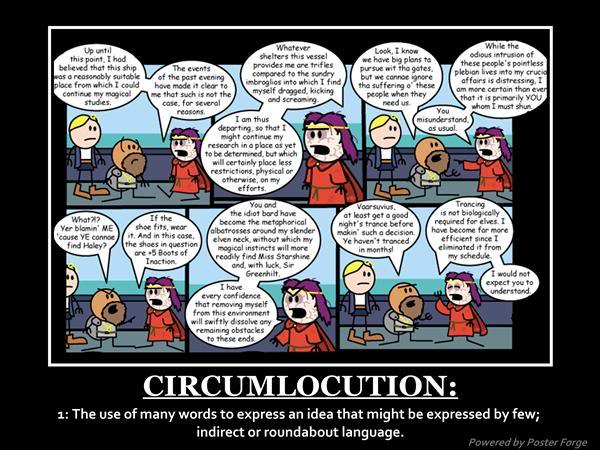
1. Circumlocution: the use
of many words where fewer would do, esp. in a deliberate attempt to be vague or
evasive.
2. Classicism: is a
specific genre of philosophy, expressing itself in literature, - Odyssey is a
classic Greek story.

3. Cliché: a phrase or
opinion that is overused and betrays a lack of original thought

4. Climax: the most
intense, exciting, or important point of something; a culmination or apex.

5. Colloquialism: (of
language) used in ordinary or familiar conversation; not formal or literary. -

Literary Terms #2
Circumlocution: the use
of many words where fewer would do, esp. in a deliberate attempt to be vague or
evasive. "his admission came after years of circumlocution"
Classicism: is a
specific genre of philosophy, expressing itself in literature, - Odyssey is a
classic Greek story.
Cliché: a phrase or
opinion that is overused and betrays a lack of original thought – “Life is
difficult, we need to overcome problems”
Climax: the most
intense, exciting, or important point of something; a culmination or apex. - The climax of the song is the most dramatic part.
Colloquialism: (of
language) used in ordinary or familiar conversation; not formal or literary. - "Hey."
Comedy: professional
entertainment consisting of jokes and satirical sketches, intended to make an
audience laugh. – Cat’s Cradle is Von’s famous comedy.
Conflict: a serious
disagreement or argument, typically a protracted one. – The conflict in Twlight
is that Edward is a vampire.
Connotation: an idea or
feeling that a word invokes in addition to its literal or primary meaning
Contrast: the state of
being strikingly different from something else, typically something in
juxtaposition or close association.
Denotation: the literal
or primary meaning of a word, in contrast to the feelings or ideas that the
word suggests. - "beyond their immediate denotation, the words have a
connotative power"
Denouement: the final
part of a play, movie, or narrative in which the strands of the plot are drawn
together and matters are explained or resolved.
Dialect: a particular
form of a language that is peculiar to a specific region or social group.- "this
novel is written in the dialect of Trinidad"
Dialectics: the art of
investigating or discussing the truth of opinions.
Dichotomy: a division
or contrast between two things that are or are represented as being opposed or
entirely different.
Diction: the choice and
use of words and phrases in speech or writing. -
Didactic: intended to
teach, particularly in having moral instruction as an ulterior motive. "Tortoise and the hare."
Dogmatic: inclined to lay down principles as incontrovertibly
true.
Elegy: a poem of
serious reflection, typically a lament for the dead. - Funeral speeches
Epic: a long poem,
typically one derived from ancient oral tradition, narrating the deeds and
adventures of heroic or legendary figures or the history of a nation.
Epigram: a pithy saying
or remark expressing an idea in a clever and amusing way.
Epitaph: a phrase or
statement written in memory of a person who has died, esp. as an inscription on
a tombstone
Epithet: an adjective
or descriptive phrase expressing a quality characteristic of the person or
thing mentioned.
Euphemism: a mild or
indirect word or expression substituted for one considered to be too harsh or
blunt when referring to something unpleasant or embarrassing
Evocative: bringing
strong images, memories, or feelings to mind. -
Thursday, January 9, 2014
AP Prep Post 1: Siddhartha
1. Siddhartha features substantial activity and narrative action. At the same time, it is about one man’s largely internal spiritual quest. What is the relationship between the internal and exterior worlds of Siddhartha? How does Siddhartha negotiate these worlds?
- Well, this question isn't really an AP questions, but this shows that Siddhartha's problems that he has to overcome. He often questions himself to become better and to find enlightenment.
2. Discuss the ways Siddhartha attempts to attain spiritual enlightenment. Which approaches are successful? Which ones are not successful, and which ones have limited effectiveness? How does Siddhartha progress from one approach to the other?
- I can't really answer this one because I don't remember reading this book. All I know is that Siddhartha went on a journey to find his enlightenment, but on the way he meets a girl who will carry his son when he passes.
3. Consider Siddhartha’s relationship with Govinda. How are they similar, and how are they different? What are the narrative functions of Govinda’s reappearance throughout the novel? How does their relationship impact the novel’s ending?
- This will be probably a free response question, because it's a universal and different interpretations can be made from this question. Again, harder to answer because I don't remember the book as much.
4. Herman Hesse’s novels before Siddhartha focused on alienated young men who rejected the cultures of their upbringings. However, these other novels did not feature the spiritual elements of Siddhartha. How do the spiritual elements of Siddhartha make it different from any other story of an alienated youth?
- This question can be a great essay topic, it talks about other novels similar to the topic of Siddhartha and the elements used in the book. I would use Pride and Prejudice as an example of someone searching for a need. In Pride and Prejudice, the sisters were all looking for love.
5. Siddhartha concerns the quest for spiritual enlightenment, and by the end of it four characters have achieved this goal: Govinda, Gotama, Vasudeva, and Siddhartha. Is the enlightenment achieved by each of these characters the same? Why or why not? What distinctions and similarities exist between the paths these characters use to reach their final goal?
- This can be made into an essay topic because it's a diverse answer. Opinions are written, and a lot can be written on the AP test because it's asking about individual enlighten. The distinctions and similarities can be written without a right answer.
Wednesday, January 8, 2014
Hacking My Education
I've always been interested in the medical field, I constantly want to know more and research more. ALthough, I may not not be the most intelligent person, I can still persue my passion. The skills I need for my educations is determination and passion. If I wanted something, I will have to work for it. The experience is obviously do something I would like to do. I think high school and few things I have been through have made me wanting and looking for what I want out of my life. Since, I only have one chance, I want to make it the best out of it. I can create a personal network by creating a page or blog for people who want to persue similar passion as me.
What's in this for me?
Well, I took this class for many reasons, some are serious and other not so much. I took this class to prepare myself for the AP test, I would and intend to pass the test because I need to save much money as possible in college in order for my plan for graduate school to go. Another reason is to help my GPA, knowing I will get a B in AP Biology, I needed another class, and I saw this as an opportunity. Finally, I've been with people who are in this class since freshman year. People who take AP are the same people every year. Many of the people sitting in my class, I won't see for a long time. It's nice to see their faces one last time before everyone goes their separate ways.
Saturday, December 21, 2013
Life After This Blog Post
Well, last time I did this was sophomore year and I got the email from myself during the summer. Let's just say, it was a complete disappointment. Reading the email made me realize that I should have tried harder over junior year and part of senior year to make myself more applicable for college. I don't really want to write another one because I will be in complete disappoint again a few months later. The things I will ask myself will be, "What college did you get into?" or "Have you decided what you are going to do with your life?" By the time the email arrives, I will have found out what college I have gotten into. But then at the same time, I can ask myself if i'm okay, if i'm happy, healthy, etc. It's exciting to look back and remember when you wrote in the mail.
Sunday, December 1, 2013
Essay Practice
Practice Essay Outline ->
Beginning/Opening:
Ignorance and narrow minds are the key element
in both Plato’s Allegory of the Cave
and Sartre’s No Exit. The prisoners
in the cave were chained to only see towards the cave wall, which brought
limitation to their minds. On the other hand, the three characters, Estelle,
Inez, and Garcin were all at each other’s throats are they are sitting in an
empty room eternally in hell.
Body Paragraph #1:
·
Estelle in No
Exit, she asks Inez and Garcin which one of them is the torturer. She seems
to be very shallow about the fact she is in hell. Also, the first thing she
asks is if there is a mirror, she is ignorant enough to not understand or come
to a realization that she is in hell and will be tortured by Inez and Garcin.
The reasons why Sartre would place Estelle into hell with Garcin and Inez was
because she affects the two of them individually.
Body Paragraph #2:
·
The prisoner and Estelle are similar in the
sense, they don’t really realize that they are trapped and their surrounding is
“hell” even if it’s an empty room or a cave with fire. The prisoners have a
narrow mind which they don’t realize because when they are enlightened with the
newfound knowledge, they are able to proceed with freedom. In No Exit, Estelle
is unable to escape, but she also comes to a realization that she was really in
hell because of Inez and Garcin. Garcin says, “Hell is other people,” meaning
the people around brings hell to you. At the end, both the prisoner and Estelle
are enlightened by the understanding of their life.
Conclusion:
·
Estelle is very stubborn in a way she can’t
comprehend what is going on. Similar to the prisoners in Plato’s Allegory of
the Cave, they were unable to understand the word outside of the cave; they
believed whatever appeared on the shadow. In Estelle’s case she tries to seduce
Garcin and stabs Inez repeatedly on the chest but lacks the understanding of
that they are all bound in hell forever. In both Plato and Sartre’s stories,
the show ignorance as a barrier and imitation to knowledge.
I Can Read
I think I made about 10 mistakes. Stumbled on few words then corrected myself.
I read it in about 5:23 minutes. Dr Preston read it in about 4:42 minutes. So I guess I made more mistakes and read it slower. . .
Video here.
I read it in about 5:23 minutes. Dr Preston read it in about 4:42 minutes. So I guess I made more mistakes and read it slower. . .
Video here.
Monday, November 25, 2013
Thinking Outside of the Box
Plato uses a cave to
symbolize the limitation to knowledge and the prisoners being chained and
forced to look at the cave wall. On the other hand, Sartre used an empty room,
placing three people in Hell. Both short stories are putting people in to a
test. Plato tests the ignorance in prisoners and Sartre tests the Inez, Garcin,
and Estelle in an empty room together.
The irony in “No Exit” is
shown through the characters’ conversation. In the beginning, Estelle, Inez,
and Garcin questioned each other who the “torturer” was. As the story develops,
the audience reveals the three character’s weaknesses. Garcin is tortured by
Estelle because he is called a coward. Estelle is tortured by Garcin because
she wants his love, but he doesn’t give it to her. Finally, Inez tries to
seduce Estelle by asking her to be her mirror, yet Estelle rejects Inez. The
irony in the allegory is the cave itself,
the cave is supposed to teach the prisoners about knowledge yet they are
shackled and forced to face the wall of the cave. In the “Allegory of the Cave,”
it seems like they are in Hell at first, but they have a good life afterwards.
In “No Exit,” it’s the opposite, Estelle, Inez, and Garcin all had good lives
before, but end up all in Hell.
The characters are all
flawed in both stories, in the “Allegory of the Cave,” the prisoners are ignorant
and believe that there is no life outside the cave. Their knowledge is very
limited which is a flaw, because their lives have revolved around the organisms
that pass through the cave. In “No Exit,” Garcin ran away from the country and
mistreated his wife by sleeping with other women. Estelle cheated on her
husband then drowned her baby, which lead up to her husband killing himself.
Inez seduced a man’s wife and kills the husband of her lover. The characters in
“No Exit” are flawed because they all ran away from their problems, but running
away from their problems led them to eternal Hell.
The “Allegory of the Cave,”
the moral of the cave is for the prisoners to have enlightenment with knowledge
when they leave the cave. The prisoners come to a realization when they are
released in outside of the cave. Their knowledge becomes beyond the limitation.
The allegory in “No Exit” is that the setting of the place may not be Hell, but
the people around you can make it Hell.
Sunday, November 24, 2013
Questions on "No Exit"
1. Think about the place you
have chosen as your hell. Does it look ordinary and bourgeois, like Sartre's
drawing room, or is it equipped with literal instruments of torture like
Dante's Inferno? Can the mind be in hell in a beautiful place? Is there a way to
find peace in a hellish physical environment? Enter Sartre's space more fully
and imagine how it would feel to live there endlessly, night and day:
-
I believe
my hell would be ordinary and plain. Well, I would prefer hell to be bourgeois
like Sartre’s room rather than torture like Dante’s Inferno. I think anywhere
can be hell, an endless everlasting garden to a pitch black room. The only way
to find peace is to sleep, or knock out. Other than that, I would probably day
dream to make things better than it seems. If I was in Sartre’s space, I think
I would be better off because it seems similar to an asylum than hell. Some
people say being in an asylum is hell, but anything is better than being beaten
or tortured.
2. Could hell be described as
too much of anything without a break? Are variety, moderation and balance
instruments we use to keep us from boiling in any inferno of excess?
-
Hell is
anywhere that is a sense of prison, isolation, and asylum. Sartre’s hell is a
different version from most versions. It’s a simple drawing room. The characters
in the story do not realize they are in hell, because the images we have of
hell is the like Dante’s inferno. Torture devices and flames are what represent
hell in our minds.
3. How does Sartre create a
sense of place through dialogue? Can you imagine what it feels like to stay
awake all the time with the lights on with no hope of leaving a specific place?
How does GARCIN react to this hell? How could you twist your daily activities
around so that everyday habits become hell? Is there a pattern of circumstances
that reinforces the experience of hell?
-
Sartre
creates indirect characterizations in the dialogue for the audience to understand
the emotions and personality through what the characters have to say. I can
imagine to stay awake, I honestly like the light than the dark. There’s no
hope, but at least I can still think about all my memories in the past. Garcin
doesn’t really realize he is in hell until he confesses his sins. I will find
something to do every day. Talking to people is a good time killer. I think
Garcin, Estelle, and Inez is lucky to have each other, although they fight.
Since, you are in hell, there’s a freedom of not doing anything forever. You
may be bored on some days, but other days might be interesting in hell.
Thursday, November 21, 2013
Allegory of the Cave Sonnet
Chained prisoners forced to look on the wall of the cave
Lights flicker as living creatures pass through the dark
To look only at the wall as if they are in their grave.
The prisoners were to only see the shadows the fire spark
The ignorance in the minds of the slaves
The unknown about the outside world or reality
They are bound to be forever in the caves
Narrow minded men who Plato pity
One prisoner let out into the open fields
The shadows are no longer projected on the wall
A newly discovered world revealed
Where green trees and leaves fall
The new aspects of knowledge discovered
Freedom is granted, the enlighten prisoners are no longer anchored
Lights flicker as living creatures pass through the dark
To look only at the wall as if they are in their grave.
The prisoners were to only see the shadows the fire spark
The ignorance in the minds of the slaves
The unknown about the outside world or reality
They are bound to be forever in the caves
Narrow minded men who Plato pity
One prisoner let out into the open fields
The shadows are no longer projected on the wall
A newly discovered world revealed
Where green trees and leaves fall
The new aspects of knowledge discovered
Freedom is granted, the enlighten prisoners are no longer anchored
A Brain with 6 Legs
Brenna, Allyson, Rachel, Melissa, Becky, and I are working together on The Great Expectations. We are probably going to use Facebook to connect with each other. We have divided up the categories to give each individual a job to do. For example, I look for difficult vocabulary then post it on to the Facebook page, where then we can post it directly to our blogs.
Thursday, November 14, 2013
Plato's Allegory of Cave
1. 1. According to Socrates, what does the Allegory of
the Cave represent?
- The "Allegory of the Cave" represents the imaginations we
create in our minds. The people in the cave are taught to believe the things we
see with our eyes. Socrates uses the people who are chained be unable to see
the real animal passing by. The fire projects the shadows of the creatures,
using our imaginative minds, we create our own names, characterizations, and
etc from what we know.
2. What are the key elements in the imagery used in the
allegory?
- The cave represents prisoners who
are innocent, the shadows are the imagination and false realities, the sunlight
represents the intellectual world and reality, the prisoner who walked out the
cave represents the philosophers like Plato.
3. What are some things the allegory suggests about the
process of enlightenment or education?
- The education and enlightenment are learned
from the images we are given. The images set our imaginations to a reality.
Plato believes people are enlightened by education, for example, in the cave,
every time an unknown specie came up and projected on to the wall of the cave,
the prisoners were enlightened.
4. What do the imagery of "shackles" and the
"cave" suggest about the perspective of the cave dwellers or
prisoners?
- The cave is represented by the world of imagination.
Since they are so limited with their knowledge, the cave dwells on the
prisoners from being educated. The “shackles” represents the prisoners
limitation and inescapable from the darkness and flickering lights.
5. In society today or in your own life, what sorts of
things shackle the mind?
- In
society today, I believe shackles are for people who have done the wrong
things, committing sins, etc. Everyday people try and do the right things,
innocent people get involved with people who should be prisoners. People in
shackles are meant to suffer.
6. Compare the perspective of the freed prisoner with the
cave prisoners?
- The freed prisoner has an emotional state of
being able to see what’s real and what wasn’t. The images we create in our
minds are different from reality. The freed prisoner was able to taste, touch,
and ultimately see the reality.
7. According to the allegory, lack of clarity or
intellectual confusion can occur in two distinct ways or contexts. What are
they?
- The
prisoners that were restricted to only the views of what the shadows confusion
and lack of clarity happens in two distinct ways which were that they were
unable to express the shadows in to words because they didn’t understand what
it was, and the confusion was how the shadow expressed on the wall of the cave.
8. According to the allegory, how do cave prisoners get
free? What does this suggest about intellectual freedom?
- The
prisoners were let go in to the real world, it’s basically an intellectual
freedom because they were in the cave seeing shadows but when the prisoners
were released, they were able to actually see what they saw on to the shadows.
9. The allegory presupposes that there is a distinction
between appearances and reality. Do you agree? Why or why not?
- Yes, there
is a huge difference between appearances and reality because it may seem like
something is real, such as a dream but in reality it may seem like that was
real. In the cave, the prisoners were able to only see shadows, no color,
texture, or anything. It’s difficult to wrap around a concept with only an
imaginations and nothing else.
10. If Socrates is incorrect in his assumption that there is
a distinction between reality and appearances, what are the two alternative
metaphysical assumptions?
-
People will only believe what they see because that’s the only knowledge they
have, and people would have extremely narrow and boring minds because a shadow
doesn’t give you much information.
Tuesday, November 12, 2013
We Hang Together
- Strategic Alliance- referred specifically to governance structures involving an imcomplete contract between separate firms, in which each partner has limited control.
- Business today, interdependence as important.
- Strategic alliance refers to the sorts of collaborative relationships and endeavors.
- Leaders can no longer adopt strategies that are based off of self interest. Nor, a one size fits all approach.
- The ability to work with others is MORE fundamental than alliances because we depend on others.
- To achieve independence, sacrifices of teamwork and belonging to someone greater than oneself.
- Collaboration allows us to be dependent on other's knowledge
Kill two assignments with one blogpost.
Mindmaps...
I'm not sure if they are the best idea, it may make sense to the creator or creators, but confusing from a person on the outside. I may be wrong, it wouldn't hurt to try.
Monday, November 11, 2013

Sunday, November 10, 2013
A Poetic Inquiry
My big question is about the unfairness in life. We often come across people who are gifted and wonder why were not given the same talent. The sonnet I found by Dr. John Celes, related with my big question because the sonnet talks about the unfairness in life and everywhere we go. The sonnet explains that whether in Heaven or Hell, unfairness will be within a person side to side.
Sonnet: Unfairness
Unfairness lives in every heart and mind;
Unfairness thrives in every earthling’s home;
Unfairness comes from siblings too, I find;
Earthlings are like uneven teeth of comb.
Unfairness occurs ev’n amidst most beasts;
Unfairness is seen ’midst the leaves of trees
Unfairness stays whenev’r the devil feasts,
And with the Apocalypse, it will cease.
Unfairness stems from world that’s within me;
Have I been fair to God who made me man?
Unfairness fills the world ’round me truly,
But it was man who did its sparks much fan!
Unfairness came with our first parents’ sin;
God’s Judgment fair will ultimately win.
6-8-2001
Unfairness thrives in every earthling’s home;
Unfairness comes from siblings too, I find;
Earthlings are like uneven teeth of comb.
Unfairness occurs ev’n amidst most beasts;
Unfairness is seen ’midst the leaves of trees
Unfairness stays whenev’r the devil feasts,
And with the Apocalypse, it will cease.
Unfairness stems from world that’s within me;
Have I been fair to God who made me man?
Unfairness fills the world ’round me truly,
But it was man who did its sparks much fan!
Unfairness came with our first parents’ sin;
God’s Judgment fair will ultimately win.
6-8-2001
Dr John Celes
Tuesday, November 5, 2013
Hamlet Remix.
My version of the Hamlet remix is to make a timeline of the play with pictures or representations of the scenes. For example: the beginning when the guards see the ghost of the king. I would put this photo as a representation of King Hamlet's ghost. I am planning to use modern photos to make it a little more comical, yet cover all the details in Hamlet. :)

This photo will obviously represent the ghost of King Hamlet.

This photo will obviously represent the ghost of King Hamlet.
Sunday, November 3, 2013
Hamlet Essay
In Shakespeare’s Hamlet, a young prince is devastated by
the fact his father has died and his mother married his uncle, Claudius, who
killed Hamlet’s father. With his only motive, revenge, Hamlet struggles with his
emotional and physical state and in conclusion many of unrelated characters
die. His soliloquies represent his beliefs and feelings, yet he has trouble
using those emotions to avenge his uncle. The method of performance utterance
and self-overhearing involved throughout the play, Hamlet, is a way to relate
to the growth in being of the title character and develop an understanding for
why he does or doesn’t follow through in his decisions. “This above all: to
thine own self be true, And it must follow, as the night the day, Thou canst
not then be false to any man.” This quote shows that Hamlet is true to himself,
he will do what he has started, which slightly contradicts the Performative Utterance article. Bloom
and Austin were able to analyze Hamlet’s reactions and found a realization for
Hamlet unable to communicate his emotions which results in a change of
character and plot.
Hamlet’s attitude towards different
characters is different from each other. For example, King Claudius and Queen Gertrude
believe that Hamlet is unsettled by the death of his father, but Hamlet makes
them believe that so his plan won’t be discovered. “Come, come, you answer with
an idle tongue.” He confesses to his mother about the death of her husband, but
she realizes that Hamlet is speaking badly of his uncle. The performance
utterance article says that Hamlet is unable to express his feelings in to
action, which is true. Hamlet uses a mental game to make everyone believe that
Hamlet is either extremely upset or going crazy. The characters are portrayed
by Hamlet’s thoughts, because he shows his real anger to only certain amount of
people.
The plot is controlled and swayed
by Hamlet’s decision on his revenge. If
Hamlet was able to express and confess his love for Ophelia, instead of lying
and acting as if they don’t, Ophelia could have lived. He was supposed to get
revenge for his father, but Hamlet involved everyone around him. He killed
Polonius with his own hand, which leads to Laertes to kill Hamlet. The hatred
for Hamlet by Ophelia and Polonius’ family is because Hamlet’s actions of
toying with Ophelia’s feeling which leads her to her death. Also, Hamlet
involved his mother by serving a poisonous tea to King Claudius, his father
(the ghost) specifically asked Hamlet not to have his mother involved, but
Hamlet’s temper got Queen Gertrude killed. “Till that her garments, heavy with
their drink, Pull'd the poor wretch from her melodious lay, to muddy death.”
Hamlet’s manipulative attitude to
kill King Claudius has led many other conflicts in the way. I don’t believe
that Hamlet was exactly confused or unable to express his feelings, but the
evidence in the text shows that many times it would have been better if Hamlet
mentioned something. The character itself shows a complex knowledge with the
communication with the ghost. The performative utterance believes that Hamlet
showed a difficulty in decision making, “William Shakespeare's Hamlet (1600)
has often been described as a play about a man who could not make up his
mind.” I disagree, because Hamlet has
achieved his goal of killing Claudius, he never had second thoughts. Also, his soliloquy
about suicide just shows that he was thinking about it, but it didn’t mean he
had a difficult decision between living and suicide.
Wednesday, October 30, 2013
Vocabulary
Aficionado: A person who is very knowledgeable and enthusiastic about an activity; an expert or connoisseur.
- I am an aficionado when it comes to playing golf because I have played it for so long.
Browbeat: To intimidate someone into doing something, using abusive words; to bully or force.
- People who are browbeaten usually end up in some sort of depression or suicide.
Commensurate: In proportion; equivalent or correspondent
- one half is a commensurate to .5 in math.
Diaphanous: Light, delicate, and translucent; gossamer.
- Her shirt was a diaphanous, not very appropriate for school.
Emolument: A salary, fee, or profit from employment.
- I earn an emolument of ten dollars a hour.
Foray: A sudden attack into enemy territory; a raid; a venture outside one’s usual area.
- Polonius was a character that was foray by Hamlet.
Genre: A category of artistic composition characterized by similarities in form, style, or subject; a classification.
- Dark Romanticism is a genre written in the late 1800's.
Homily: discourse on or of a moral theme; a sermon or lecture.
- I was homily after passing notes in my English class.
Immure: enclose or confine someone against their will; to imprison.
- police officers have immure many people everyday for using drugs.
Insouciant: Showing a lack of concern; nonchalant; indifferent
- I felt insouciant after finding out a girl failed her test when she didn't eve study.
Matrix: An environment or material in which something develops; a situation within which something else originates.
- I felt that the environment was going to matrix after getting non pollinating cars.
Obsequies: Funeral rites or services.
- Obsequies make me uncomfortable because the death of people makes life depressing.
Panache: Flamboyant confidence of style or manner; flair or zest.
- She felt panache after winning prom queen.
Persona: The aspect of someone’s character that is perceived by others; a voice or character representing the speaker.
- When Boo from Monsters Inc says "Kitty" we often recognize her voice as a persona.
Philippic: A bitter attack or denunciation; criticism.
- I ended up philippic after my friend yelled at my boyfriend.
Prurient: Having an excessive interest in lustful thoughts and desires.
- I have a prurient towards this guy in my English class.
Sacrosanct: regarded as too valuable to be interfered with; sacred; untouchable.
- The ivory necklace sitting on the cabinet is a sacrosanct.
Systemic: Of or relating to a system, as opposed to a particular part.
Diffusion is a systemic to photosynthesis.
Tendentious: Favoring a particular cause or point of view that is controversial or may cause argument.
- many people believe that stem cells are a tendentious thug because humans can't act like god.
Vicissitude: A change of prevailing situations or fortune.
- I felt vicissitude after finding several letters leading to my locker.
Tuesday, October 29, 2013
Thoughts On Hamlet (IN PROGRESS)
I honestly feel like that the ghost is just Hamlet's conscience because his mother can't obviously see the King so I believe that's how he communicates with his mind. I think Claudius is after Hamlet, he might to try to kill him and make the people and the queen believe that it was for justice because Hamlet killed Polonius. Or persuade the crowd by saying how Hamlet is going crazy, although, Ophelia becomes crazy and Hamlet is possibly acting. Hamlet might leave to England for a little while, but I think Claudius will still manage to be able to kill Hamlet.
The Performative
Utterance in Hamlet Notes:
- Many people have
different opinion Hamlet's attitude, some believe that he is actually crazy,
but others think it is all a play. In this article, the author believes that
Hamlet is trapped and unable to communicate with his feelings, “Hamlet is
trapped in a kind of cognitive paralysis, convinced of his duty and yet unable
to move that duty from the mental to the real.” The author also believes that
he has this power yet he can’t do anything but speak.
- The article says that
Hamlet does not swear to avenge his father, but I disagree. In the play Hamlet
makes it pretty clear that he will take down Claudius.
-“It could be said with
only a little exaggeration that the central problem of the play is that people
represent their feelings and their intentions in ways that are contrary to
reality. The major way in which intention is misrepresented in Hamlet is
through the act of mimesis, a subtler kind of play acting than the one undertaken
by the players, and one which demands attention.” I don’t think the
exaggeration of the central problems leads to Hamlet as misleading. The exaggeration
and characters with flaw combined is what the play is about.
Sunday, October 27, 2013
What I Think About When I Think About ACT III
In Hamlet ACT III Scene I, Hamlet has his "To be or not to be" speech and I thought about the usage of the words he says. Such as "To die, to sleep" I think that Hamlet is referring to death and sleeping as the same thing. He can try to commit suicide because dying and sleeping is exactly the same type of thing. But then he sees Ophelia who is hiding, Hamlet tells her to become a nun to control herself. I believe this is all an act for Hamlet, he probably loves Ophelia. I think the play was effective, because Claudius leaves. When Hamlet killed Polonius, I thought it was dramatic, and Hamlet is in rage with himself causing him to become rational.
Thursday, October 24, 2013
Literature Analysis #3
Literature Analysis: The Picture of Dorian Gray by Oscar
Wilde
1. Plot: The book sets in Lady Brandon’s house in London.
Where a well-known artist Basil Hallward meets Dorian Gray, who is extremely
handsome, wealthy, and pompous; Basil is captured by Dorian’s beautiful face
and he wanted to paint a portrait for Dorian. Dorian sees the painting, but he
is disappointed because it reveals too much of his feelings for him. Lord Henry
claims that the portrait is Basil’s masterpiece. Basil is worried that Lord
Henry might ruin the image of Dorian because he will have a damaging influence on
Dorian. By the end of their conversation, Lord Henry makes a speech about the
nature of beauty and youth, Dorian takes the speech in and worries about the
characteristics that fade day by dat. Dorian curses the portrait because it
reminds him about the beauty he will have lost. The influence of Lord Henry increases;
now Dorian falls in love with Sibyl who is a dancer, and she also falls in love
with him so much that she can no longer dance. Dorian falls out of love and
Sibyl kills herself. The portrait transforms and ages but Dorian doesn’t.
Dorian sees the painting and kills Basils. After, he escapes from Vane and
disposed Basil’s body, he looks at the hideous painting and stabs the portrait.
The servants found old and ugly Dorian on the ground with a knife in his chest.
The author’s purpose is to show readers about the horrors and consequences of obsession.
He did this by showing that the portrait sitting in Dorian’s attic gradually
ages in to a hideous man, but Dorian is yet still the same. His fear reversed
yet Dorian was still feared about his lost beauty.
2. Theme: The theme of this book is the curse of obsessing.
Dorian was obsessed with his image and beauty that he feared that his painting
will be a forever reminder that he was once young. Wilde shows the consequences
of obsessing over things that don’t matter. Dorian was extremely self-confident
and proud of his image, but because of his arrogant matter, it drove him to
death. Many obsession lead to death, in the book, Dorian becomes mental and
stabs the portrait which lead him to death. Another theme is influences, the
books shows that Lord Henry’s influences caused Dorian to become so obsessive
and compulsive. Basil feared about Henry’s actions and reputation which he was
right, Dorian became extremely concerned about his image.
3. Tone: Oscar
Wilde’s tone was very calm but mystifying. His use of syntax and diction made
the novel much more compelling and dramatic. [Some of the things he says are
quite philosophical.] ‘’Dorian Gray lifted his golden head from the pillow, and
with a plaid face and tear-stained eyes looked at him, as he walked over to the
deal painting-table that was set beneath the high curtained window.” “All art
is quite useless.’” Also, Wilde’s tone had of deep knowledgeable quotes such as,
“Life always has poppies in her hands.”
4. Literary Techniques:
Foreshadowing:
Imagery: Wilde uses a
lot of imagery to show the complex details of the story. “Children begin by
loving their parents; as they grow older they judge them; sometimes they
forgive them.”
Foil: The foil character in the book was Lord Henry because
he swayed Dorian’s decision and made him become compulsive about his beauty. “Nowadays
people know the price of everything and the value of nothing.”
Irony: What’s ironic about the book was that Dorian knew
from the beginning that he was marvelous, wealthy, and handsome, yet he still
believed in what Lord Henry said about beauty. Usually pompous people don’t
think about what others have to say. “I am too fond of reading books to care to
write them.”
Symbolism: The portrait of Dorian symbolizes the blackened
souls of society. The portrait represents the opposite of society. Society
always wants the beautiful handsome men and women but the portrait gradually
became hideous over time. “When one is
in love, one always begins by deceiving one's self, and one always ends by
deceiving others. That is what the world calls a romance.”
Mood: The mood is suspicious throughout the story because
the portrait will slowly change which gives a spine chilling effect to the
book. “There is only one thing in the world worse than being talked about, and
that is not being talked about.”
Narrative: The book is written in third person, many of what
the audience knows is what Dorian knows, there’s also a connection. “You will
always be fond of me. I represent to you all the sins you never had the courage
to commit.”
Tragic Flaw: The tragic flaw in the book is when Dorian
murders Basil and stabs the portrait and ends up killing himself because he did
not realize that his actual form was stuck in the portrait. There is nothing
fearful about it; it was one of the great romantic tragedies of the age.”
Allusion: An allusion that was made was the portrait is an
allusion to the beautiful European portraits of men and women. “I don't want to
be at the mercy of my emotions. I want to use them, to enjoy them, and to
dominate them.”
Diction: Wilde wrote his sentences with fairly normal
vocabulary, but he writes almost like Shakespeare, difficult to understand. “The only way to get rid of temptation is to
yield to it.”
5. Characterization: Direct Characterization- the author
uses direct characterization by using a different character from the book
explaining how Dorian is like. Dorian is an arrogant, selfish, conceded man who
believes the world revolves around him. “He grew more and more enamored of his
own beauty, more and more interested in the corruption of his own soul.”
Indirect Characterization- Wilde uses indirect
characterization on Basil, who is very shy and doesn’t talk much throughout the
book but Dorian believes its Basil’s fault for the painting. “Who could say
where the fleshly impulse arbitrary definition of ordinary psychologist!”
6. Syntax: Wilde likes to keep the book overly simple, the
setting and characterization was straight-forward and no use of complicated
words to describe something. The author loves action because the book was full
of action inside of Dorian and everyone around him. Wilde likes to be complex
and almost “busy” with his storyline.
7. The protagonist is a dynamic character because Dorian
Gray starts off as a normal wealthy man, but over time he becomes obsessive and
psyches which he ends up killing himself. The character is also rounding
because his personality is revealed over time, he starts off calm but at the
end he’s very rational.
8. I did not feel like I met Dorian, I felt like I was more
like watching a movie rather than meeting him. I personally wouldn’t want to
meet him anyway. He seems very arrogant and easily influenced by others. “Humanity
takes itself too seriously. It is the world's original sin. If the cave-man had
known how to laugh, History would have been different.” Dorian Gray is a sinful
and compulsive person and this quote explains the meaning of the painting.
Also, this is my favorite quote. J
Tuesday, October 15, 2013
Vocabulary #8
Abase: To behaving in a way so as to degrade or debase someone.
- She felt that her friend was abased by the way she talked to her
Abdicate: To renounce one’s throne; to resign or retire.
- Kings often abdicate and give the throne to their child.
Abomination: A thing that causes disgust or hatred.
- I have an abomination for bulldogs, their wrinkly faces and drooling lips makes me hate them.
Brusque: Abrupt in speech or manner.
- It was an uncomfortable event, my friend was brusque at the wedding party.
Saboteur: A person who sabotages or deliberately destroys something.
- The saboteur tried to destroy the friendship between my friend and I, but she deliberately stopped after we confronted.
Debauchery: Excessive indulgence in immoral pleasures.
- She felt in debauchery after listening to a lecture about life after death.
Proliferate: To multiply; increase rapidly in numbers.
- The world population is proliferated every single day. Fifteen years from now Africa will be more populated than Asia.
Anachronism: Something mistakenly placed in a time where it doesn’t belong; not in it’s correct historical time.
- Humans and dinosaurs living I the same era is an anachronism.
Nomenclature: The choosing of names for things (usually in science).
- Many of the recent elements of the periodic table is a nomenclature because scientists name their findings after themselves.
Expurgate: To remove objectionable material from something
- It is hard to believe people will expurgated things from the internet and claim them as their own.
Bellicose: Demonstrating aggression or willingness to fight.
- I felt the he was ready to bellicose after the argument with his friend.
Gauche: Lacking ease or grace; socially awkward
- I was in gauche because my crush was sitting next to me.
Rapacious: Greedy; ravenous.
- My aunt is very rapacious about inheriting the money from my grandfather.
Paradox: A seemingly contradictory statement that may nonetheless be true.
- We often use paradox without realizing, such as "call me when you receive this call"
Conundrum: A confusing and difficult problem or question.
- It's difficult to give an answer when the teacher asks a conundrum.
Anomaly:Something that deviates from what is normal; abnormality.
- Spider-Man gets bitten by a spider which anomalies in to a super hero.
Ephemeral: Lasting for a short time; fleeting.
- Life is an ephemeral matter.
Rancorous: Characterized by bitterness; spiteful.
- His rancorous behavior comes from his friends influences.
Churlish: Rude in a surly way; impolite; ill-mannered.
- Rarely, flight attendances are churlish because they are often scolded if a passenger feels like they are being rude.
Precipitous: Extremely steep; or an action done suddenly without careful consideration.
- In order to commit a crime, you must be sneaky and no precipitous or else you will be caught.
Subscribe to:
Posts (Atom)